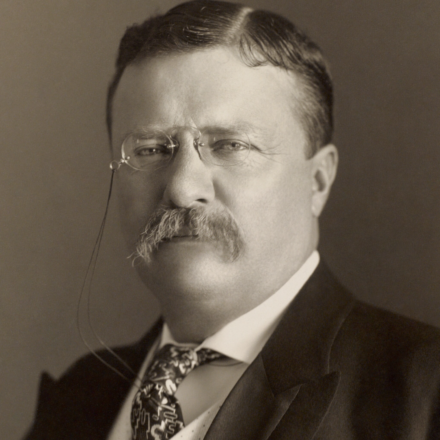
President Roosevelt was invited to speak at the Whitefriars Club, but, replying from Naivasha, British East Africa, on 6th August 1909 to the Honorary Secretary of the Club, Friar Joseph Shaylor, he wrote…
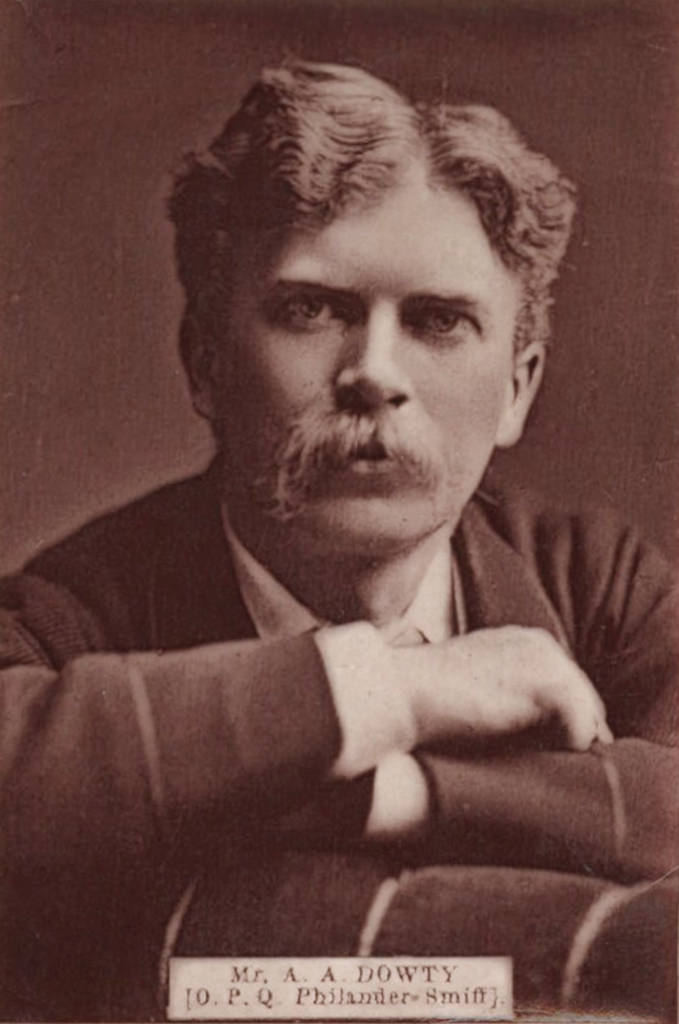
Artemas Aglen Dowty was born in Bridgwater in 1846. He was a son of Flixton Dowty (1812–75), printer and bookseller, and educated at Wesley’s College, Taunton (now Queen’s College).
When he was aged fifteen, he had a severe accident while ice-skating, and was so badly injured he abandoned all hope of matriculation for university entrance. During his convalescence, he occupied himself writing verse, which was published in the local newspaper. He submitted more verses to Tom Hood (1835–74), then editor of the comic journal Fun – and one of the founders of the Whitefriars Club – who published them. As the critic theatre Clement Scott later wrote,
Tom Hood had an influence among the younger writers and artists of his day that cannot be overrated. He was the most unselfish and least jealous of men. He loved to get his friends about him to talk shop, and to encourage one another in their various callings. Every Friday night of his life, though not particularly blessed with this world’s riches, he gave a cheery bohemian supper-party, to which the best fellows in the world were invited. Who that was privileged to attend them can have forgotten Tom Hood’s “Friday nights” in South Street, Brompton, where, after a pipe and music, conversation and poetry readings, we sat down to a homely meal of cold joint and roast potatoes, and discussed all the wonderful things that we youngsters intended to do in the future?1
Is it possible that Hood’s “Friday Nights” point to the origin of the Whitefriars’ dinners?
Dowty published more verse, but perhaps, realizing the need of a secure income, in 1867 he successfully passed the Civil Service exam. He was offered a post as a clerk in the Paymaster General’s office, and moved to London. In view of his early link with Tom Hood, it is most likely he joined the Whitefriars soon after his arrival there.
A newspaper account of a dinner held in early 1879 noted he was there:
Mr F.W. Haddon was the chief guest at a nice little dinner of the White Friars Club a few days ago, where he met Mr Charles Gibbon, the novelist; Mr Toole, the comedian; Mr William Sawyer, Mr Aglen Dowty (reputed author of The Coming K—), better known “O.P.Q. Philander Smiff”; Mr Baden Pritchard, Mr J. Crawford Wilson, Mr Wharton Simpson, Dr Robert Brown, the geographer, and many others.2
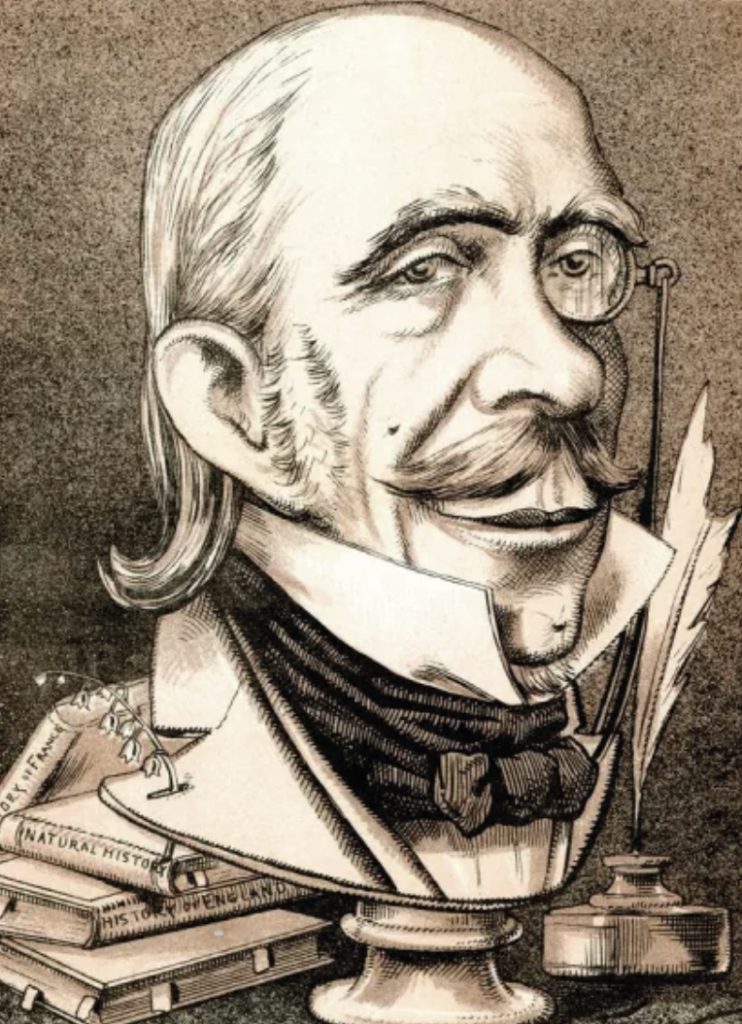
A very extensive newspaper account of November 18873 describes a Whitefriars Smoking Concert, where Friar Richard Gowing was in the chair. It describes the portraits on the walls of deceased or living members. Tom Hood and William Sawyer are mentioned, as well as Philander Smiff. This most likely relates to the portrait of a bust of Philander Smiff as the London Figaro artists envisaged him. Others whose portraits were mentioned were the novelist William Black and the actors “Mr Creswick”, Barry Sullivan and Wilson Barrett.
The article also mentions, among the attendees, several well-known authors and journalists: Harrison Weir, William Senior, Edward Marston, George Henty [G.A. Henty], Dr Robert Brown and Byron Webber.
It is hard to categorize Dowty’s humorous writing. His tone was usually of studied irony, and his work is devoid of literary quality. Much was written when he was a young man, of course, but to the present-day reader his verse seems very laboured and somewhat juvenile. His short stories, however, are amusing. It is clear he was a very prolific writer, and it would require extensive research to identify all of his writings today.
The Civil Service in the last half of the nineteenth century was a home for a number of successful writers, such as Anthony Trollope. Dowty remained until at least 1891,4 although some sources suggest that he resigned later.
From 1870 Dowty published much in the comic journal The London Figaro, including a famous series with the pseudonym O.P.Q. Philander Smiff. Many of the articles were later reprinted in book form.
Also in the 1870s he assisted Samuel Beeton (1831–77) in editing his parody of Tennyson’s Idylls of the King (the parts published in 1859 and 1872), which was merciless in its treatment of the Prince of Wales’s moral behaviour, and his fitness to be King. This caused a hostile response in the press, due to the anonymity of the authors.
The book was entitled The Coming K––, and published in 1872. It was one of Beeton’s Christmas Annuals that were published between 1860 and 1895. The earlier numbers covered seasonal topics and were safe to be read round the family hearth, but from 1872 the annuals were much more radical in tone. Dowty helped edit three more titles. One parodied Homer’s Iliad, the second Byron’s Don Juan and the third Shakespeare’s Henry IV and Henry V. After Beeton’s death in 1877, the annuals reverted to the usual Christmas style.
Dowty was also a prolific writer of short stories. A number of them have a flavour of the Grossmiths’ Diary of a Nobody – which, of course, began as a Punch serial.
For twenty-nine years, until his death in 1906, Dowty wrote a regular series of satirical verses for Truth under the title “The Barrel Organ”, which ranged over politics and the social scene. He was also the author of a lengthy year-end verse review which became a staple in Truth’s Christmas numbers.
We don’t know if Dowty was ever a White Friar or only attended as a guest, although it is likely that he joined the club at some point. New archive material could help answer this question. If he ever joined the club, he was definitely no longer a White Friar by 1900, since his name does not appear in that year’s members’ list published in The Whitefriars’ Chronicles.
Although he is regarded today as a lesser-known figure, Dowty was well known in his own time, and right at the centre of the cultural and literary world of his day. He certainly deserves to be rediscovered.
– Tony Woolrich
NOTES: 1. Clement Scott, Thirty Years at the Play, 1891, pp. 20–21. 2. Sheffield Independent, 12th April 1879. 3. Nottinghamshire Guardian, 26th November 1887. 4. Census record.
Tony Woolrich has worked as a publisher’s editor, and has specialized in industrial history and biography, as well as local history. He has contributed to the Oxford Dictionary of National Biography, the Biographical Dictionary of Civil Engineers and Wikipedia. He spotted A.A. Dowty in a bibliography of Somerset books, where his book of dialect rhymes was listed as being by O.P.Q. Philander Smiff. So the urge to learn more was not to be resisted.